Poolside Artificial Turf: The Complete Guide for Charlotte & Lake Norman Pool Owners in 2026
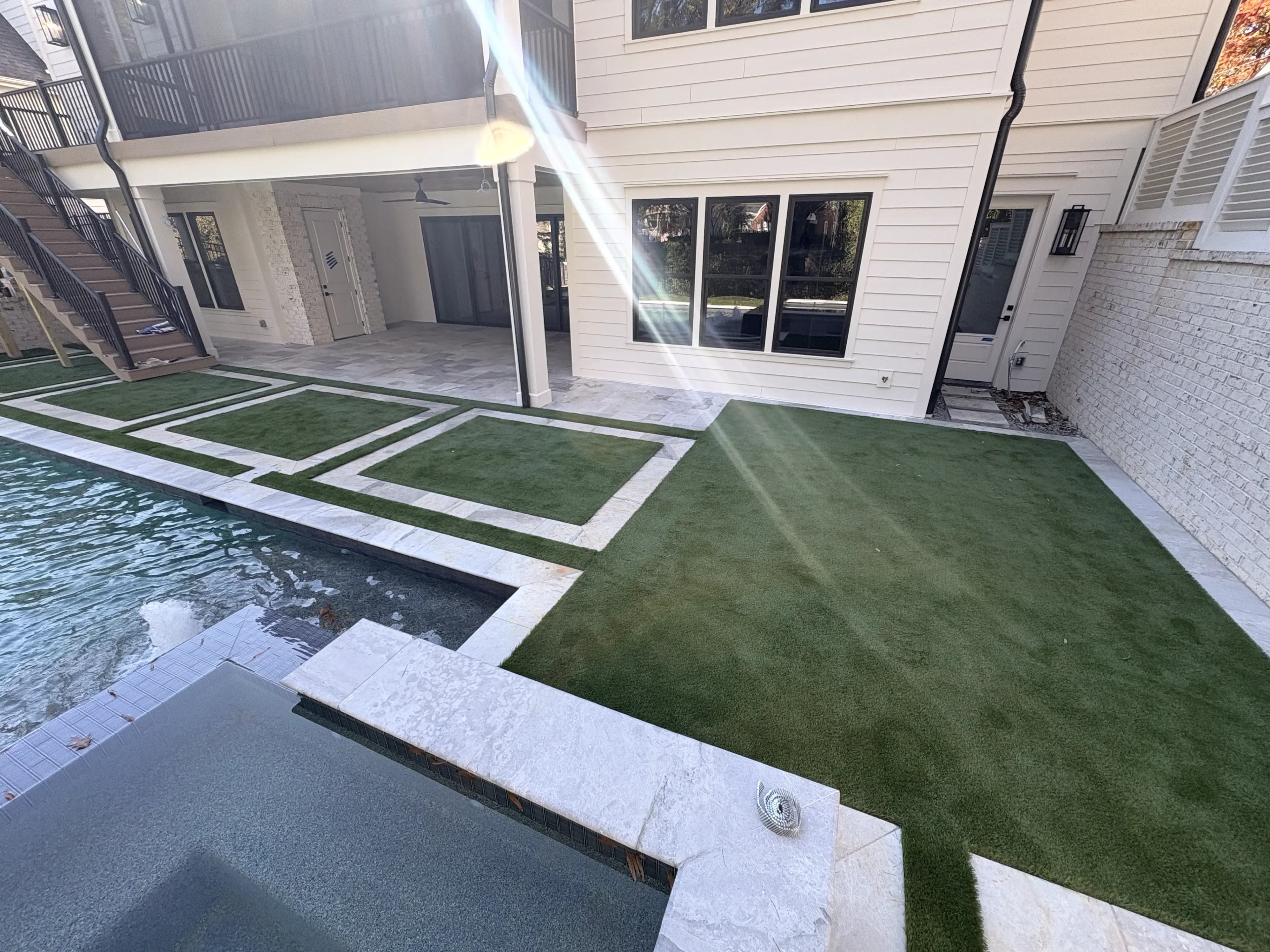
Every pool owner in the Charlotte area knows the specific frustrations of natural grass around water. Clippings blow into the pool and clog the skimmer basket. Wet feet turn the grass-to-deck transition into a permanent mud ring. Irrigation overspray drives up chemical costs and stains the coping. And the strip of lawn that gets the most foot traffic all summer is bare dirt by August.
Artificial turf around a pool eliminates all of it. But poolside is also the single most demanding environment we install into, and turf specified for a general backyard lawn will not hold up to it. Here is what actually matters.
Why Pool Owners Make the Switch
- Zero clippings, zero debris: Nothing to mow means nothing blowing into the water. Skimmer baskets stay clear and pump strain drops.
- No mud transfer: The wet-feet-to-lawn cycle that destroys natural grass and tracks mud onto the deck simply stops.
- No fertilizer or chemical conflict: Lawn fertilizer entering pool water throws off chemistry and feeds algae. Turf removes that input entirely.
- Survives constant splash-out: Chlorinated and saltwater splash kills natural grass in a defined band around the deck. Properly specified turf is unaffected.
- Consistent appearance all season: The area you actually use and photograph most looks the same in August as it did in May.
- Safer footing than many alternatives: A quality turf surface with proper base drainage offers better wet traction than smooth pavers or stamped concrete.
- No irrigation adjacent to the pool: Removes overspray, mineral staining on coping, and one more system to winterize.
Specification: What Poolside Turf Requires
Chlorine and Saltwater Resistance
Fiber and backing both need to tolerate repeated chemical exposure. Premium polyethylene fibers with UV-stabilized backing handle chlorinated splash-out and saltwater systems without discoloring or degrading. This is a genuine differentiator between product tiers — economy turf backings can become brittle under sustained chemical and UV load.
Heat Management Is the Big One in Charlotte
Charlotte summers regularly push into the 90s with high humidity, and turf in full sun gets warmer than natural grass because it does not transpire. Barefoot pool traffic makes this the most common poolside complaint, and it is addressable:
- Heat-reflective fiber technology: Fibers engineered to reflect rather than absorb infrared, meaningfully reducing surface temperature
- Lighter, multi-tone color blends: Lighter overall tone absorbs less solar energy than dark saturated green
- Cooling infill: Silica-based and coated infills run substantially cooler than crumb rubber, which should never be used poolside
- Strategic shade: Pergolas, sail shades, or mature tree canopy over the highest-traffic turf areas
- A quick rinse: Thirty seconds with a hose drops surface temperature immediately — worth knowing on the hottest afternoons
Infill Selection: Skip Crumb Rubber
Poolside infill needs to stay put, stay cool, and stay clean:
- Rounded silica sand: Heavy enough to resist migration, chemically inert, cost-effective
- Antimicrobial coated infill: Worth the upgrade where sunscreen, body oils, and food are constant
- Avoid crumb rubber entirely: It floats, migrates into the pool, holds heat badly, and can stain wet decking
Pile Height and Density
Poolside gets heavy barefoot traffic in concentrated paths. A moderate pile height in the 1.25 to 1.5 inch range with high face weight and strong memory resists matting far better than a tall, soft, low-density turf that will lay flat along the walking lines by mid-July.
Installation Details That Separate Good From Bad
Drainage Has to Handle Splash Volume Plus Rain
Pool surrounds receive far more water than a normal lawn — splash-out, deck rinsing, swimmers exiting, plus Charlotte's 43 inches of annual rainfall on our red clay subsoil. The base needs an open-graded drainage layer over geotextile fabric, graded positively away from both the pool shell and the house, with supplemental French drains or channel drains where the site concentrates flow. Water must never be directed back toward the pool structure.
The Coping and Deck Transition
This edge is the most visible detail in the entire installation and the most common failure point. Turf should be cut precisely to the coping or deck line and mechanically secured — never simply glued to a surface that sees constant water. Done correctly, the transition reads as a clean, intentional line with no gap, no lifting lip, and no visible backing.
Curves, Radii, and Seam Placement
Pools are curved; turf comes in straight rolls. Fitting a radius cleanly requires relief cutting and careful seaming, and seams should be planned to fall away from primary sightlines and away from the highest-traffic entry paths. This is craftsmanship, and it is where an experienced crew is obvious.
Working Around Equipment and Utilities
Pump lines, autofill lines, low-voltage lighting, drain cleanouts, and irrigation heads all need to be located and either protected or made accessible before base work starts. Burying a cleanout under a turf seam is a problem you discover at the worst possible time.
Design Approaches That Work Around Water
- Turf and paver inlay: Alternating stone pads with turf ribbons between them, creating rhythm and breaking up large expanses
- A defined turf lounge zone: One generous soft area for chairs, towels, and kids, with hardscape handling the wet circulation path
- Turf as the frame: A consistent turf band surrounding the deck perimeter, visually softening the concrete and unifying the space
- Putting green integration: Extremely popular on larger Lake Norman and Waxhaw properties — a two or three hole green flowing directly off the pool area
- Slope and terrace solutions: Turf holds contour on graded lakefront lots where natural grass erodes
- Pet-friendly zoning: A separate, more freely draining pet section adjacent to but distinct from the pool surround
Lake Norman and Waterfront-Specific Considerations
Properties along Lake Norman, in Cornelius, Davidson, Denver, and Mooresville bring conditions we plan for specifically:
- Steeper grades toward the water: Terracing and edge restraint matter more; turf actually outperforms natural grass on erosion control here
- Higher wind exposure: Open lake frontage means stronger perimeter fastening to prevent edge lift
- Shoreline setback rules: Duke Energy shoreline management guidelines and local buffer requirements can affect how close to the water you may disturb ground
- Dock and path connections: Turf pathways from pool to dock eliminate the worn dirt trail almost every waterfront property develops
- Seasonal-use properties: Turf requires no caretaker during months the home sits empty
Maintenance Reality
Poolside turf is low maintenance, not no maintenance:
- Weekly in season: Blow or rake off leaves and debris; rinse high-traffic paths
- Monthly: Cross-brush traffic lanes against the grain to lift fibers and redistribute infill
- As needed: Rinse sunscreen and body oil residue, which is the main poolside-specific cleanup item
- Seasonally: Check infill depth and perimeter fastening; top up infill in the busiest zones
- Fall: Stay ahead of leaf drop so organic matter does not break down into the infill
Investment Range
Poolside installations carry a premium over open lawn areas because of the curve work, precision edge detail, and heavier drainage requirements. Charlotte-area pool surrounds typically run in the range of $12 to $20 per square foot installed, depending on turf specification, the amount of radius cutting, deck transition complexity, and whether supplemental drainage is required. Smaller, highly detailed surrounds sit at the upper end of that range on a per-foot basis because the labor is concentrated.
Against that, most pool owners weigh eliminated mowing and irrigation around the pool, reduced chemical and skimmer maintenance, and no annual reseeding of the band that dies every summer.
Get It Specified Correctly
Atlantic Turf Specialists has completed pool surround installations throughout Charlotte, the Lake Norman corridor, Waxhaw, Fort Mill, and Tega Cay. We specify chlorine and saltwater resistant turf with heat-reflective fibers and cooling infill, engineer drainage for splash volume on top of Charlotte's clay subsoil, and detail coping transitions so the finished edge looks deliberate.
Planning a pool surround project? Request a free consultation or browse our completed pool installations.