Playground Turf Safety: Fall Height Ratings, ADA Access & What Charlotte Schools and Churches Must Know
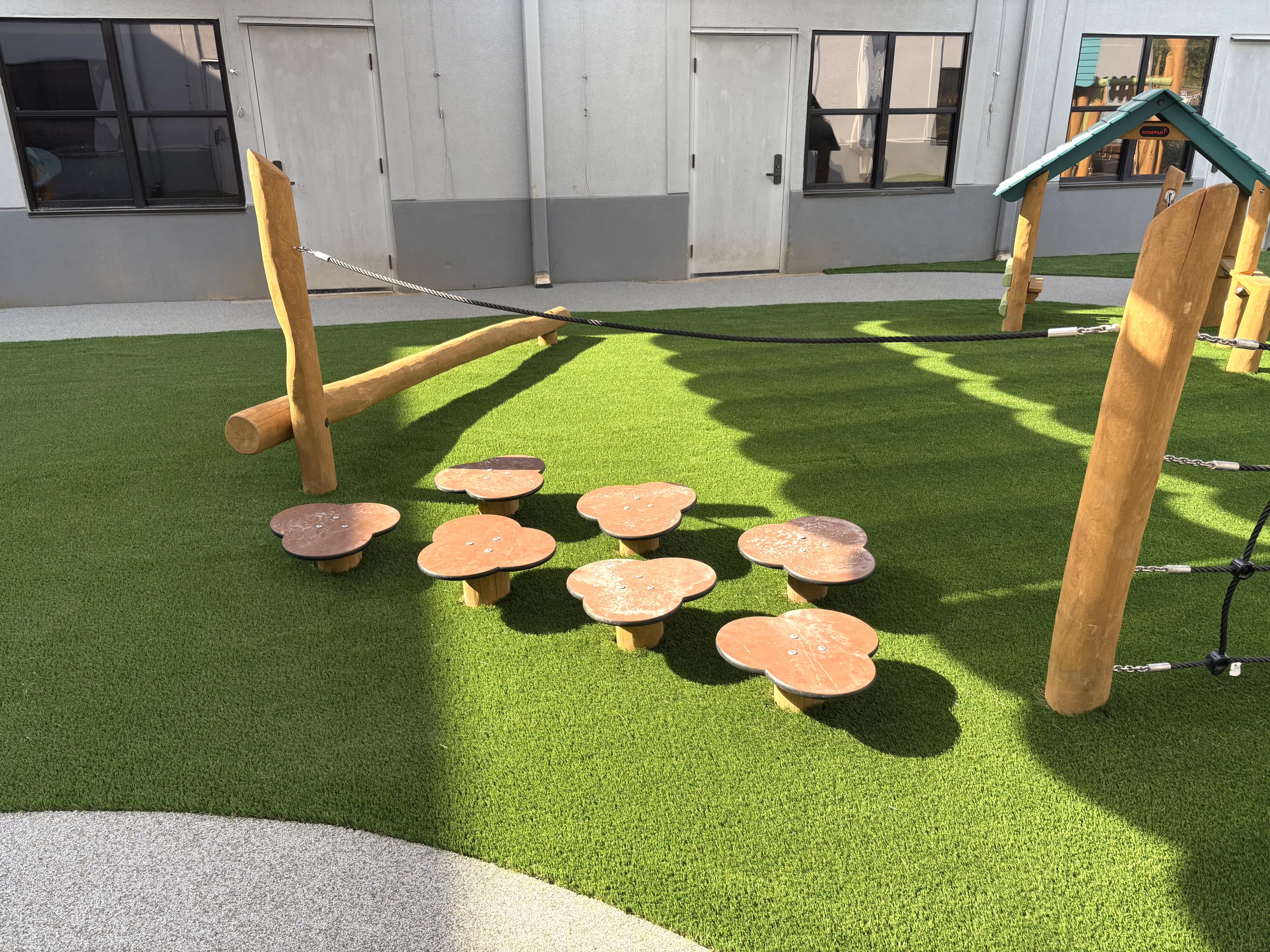
When a school, church, daycare, or municipal park installs artificial turf on a playground, the turf stops being a landscaping choice and becomes safety surfacing. That shift carries real consequences: testing standards, certification documentation, accessibility requirements, and inspection records that a licensing agency or an insurance carrier may ask to see.
We have installed playground surfacing for congregations and facilities across the Charlotte area, and the pattern is consistent — the organizations that get this right treat it as a specification exercise, not a bid comparison. Here is what actually governs playground turf, and what to require from any installer bidding your project.
The Standards That Govern Playground Surfacing
ASTM F1292 — Impact Attenuation and Critical Fall Height
This is the central standard. ASTM F1292 defines how impact attenuation is measured and establishes the critical fall height — the maximum height from which a fall onto that surface stays below the injury thresholds for head impact. Testing measures two values, and the surface must pass both:
- g-max: Peak deceleration on impact, which must not exceed 200 g
- HIC (Head Injury Criterion): Which must not exceed 1,000
The practical requirement: the tested critical fall height of your surfacing system must equal or exceed the highest designated play surface of your equipment. If your play structure has a deck at 8 feet, your surfacing system must be rated for at least 8 feet.
Critically, that rating belongs to the system, not the turf. Turf alone provides very little impact attenuation. The rating comes from the shock-absorbing pad beneath it, and it is only valid for the specific combination of pad thickness, turf, and infill that was tested together.
ASTM F1951 — Accessibility of Surface Systems
This standard measures whether a wheelchair user can actually propel across and turn on the surface, evaluating work per foot on straight travel and on turns. Compliance with F1951 is how a playground surface satisfies the accessible route requirements that flow from the ADA. Well-installed turf over a firm, properly compacted base performs strongly here — considerably better than loose fill materials like engineered wood fiber or sand, which shift under wheels and require constant re-leveling.
ASTM F1487 — Equipment and Use Zones
Governs playground equipment itself, but it defines the use zones — the surface area around equipment that must be protected. Surfacing must extend across the full use zone, which is typically a minimum of 6 feet in all directions from stationary equipment and considerably more in front of and behind swings, calculated from pivot height. A common and expensive mistake is sizing a turf area to the equipment footprint rather than to the required use zone.
IPEMA Certification
IPEMA operates the third-party certification program that validates a manufacturer's claim of ASTM compliance. An IPEMA certification reference is independent verification rather than a vendor assertion, and it is the documentation most licensing inspectors and insurance carriers recognize immediately.
CPSC Public Playground Safety Handbook
The Consumer Product Safety Commission handbook is guidance rather than regulation, but it is the reference document courts, inspectors, and carriers treat as the standard of care. It is worth having in your project file.
North Carolina Requirements for Licensed Child Care
If your facility is a licensed child care operation — which includes many church-operated preschools, mother's-morning-out programs, and daycares in Mecklenburg, Union, Cabarrus, and Iredell counties — you are also subject to North Carolina child care licensing rules governing outdoor learning environments. Those rules address protective surfacing under and around equipment, fall zones, fencing, shade, and drainage.
Two practical implications:
- Coordinate before you build. Confirm requirements with your licensing consultant during design, not after installation. Retrofitting a fall zone is far more expensive than sizing it correctly.
- Keep the documentation. Your file should include the system's ASTM F1292 test report with its critical fall height, IPEMA certification reference, pad specification, and as-built installation details. Inspectors ask for this.
Public school projects in Charlotte-Mecklenburg and surrounding districts will typically also route through district facilities standards and may require specific submittals and prevailing-wage or procurement compliance.
Building the System Correctly
The Shock Pad Determines Your Fall Height
Closed-cell foam shock pads are manufactured in thicknesses that correspond to tested fall height ratings — generally, more thickness yields a higher rating. The pad must be specified to your tallest equipment, installed continuously across the full use zone with tight joints, and laid over a base flat enough that it makes uniform contact. A pad bridging over a low spot in the base does not perform as tested at that location.
Base Preparation on Charlotte Clay
Playground surfacing sits on the same red Piedmont clay that challenges every project in this region, and here the stakes are higher because base settlement changes impact performance. A correct profile includes full excavation of organic material, geotextile separation fabric over the clay subgrade, angular aggregate placed and compacted in lifts, positive grading to a defined discharge point, and supplemental subsurface drainage where the site requires it. Standing water under a shock pad degrades both the pad and the surface above it.
Turf Specification for Institutional Use
- Shorter pile height: Typically 1 to 1.5 inches, which resists matting under concentrated traffic and stays easier to inspect
- High face weight and strong fiber memory: Playground traffic is relentless and concentrated at slide exits, swing landings, and gates
- Antimicrobial infill: Standard practice for child-occupied surfaces
- No crumb rubber: Institutional playground specifications should use silica or coated alternatives; many districts and congregations prohibit crumb rubber outright
- Lead-free, verified non-toxic materials with documentation available on request
- Heat-reflective fibers: Genuinely important in Charlotte, where mid-summer surface temperature affects whether children can use the space at midday
Installation Details Specific to Playgrounds
- Equipment post detailing: Turf cut and secured tightly around every post with no gap that can catch a foot
- Seams away from landing zones: Never place a seam at a slide exit or swing landing where impact and traffic concentrate
- Flush transitions: Every edge — to sidewalk, mulch bed, or fencing — should be flush and mechanically restrained to eliminate trip hazards
- Inlaid graphics: Hopscotch grids, tracks, sport lines, and school logos can be inlaid rather than painted, which is popular and durable
- Drainage away from gates: Entry points should never be the low spot
Why Institutions Choose Turf Over Loose Fill
- It stays ADA compliant: Loose fill needs continual re-leveling to remain accessible; turf does not displace
- Consistent, verifiable impact protection: A pad system performs the same on inspection day as on install day, whereas engineered wood fiber compacts and thins in exactly the high-traffic zones where protection matters most
- No annual replenishment budget: Loose fill is a recurring line item; turf is not
- Nothing tracked indoors: A significant practical benefit for churches and schools with carpeted classrooms adjacent to play areas
- No mud closures: Properly drained turf is usable shortly after rain, which materially increases available outdoor time in a rainy Charlotte spring
- Fewer hidden hazards: Loose fill conceals debris; a turf surface is visually inspectable in seconds
- No pest habitat or standing-water breeding sites when drainage is built correctly
Ongoing Inspection and Documentation
Whatever surface you install, maintain an inspection record. It protects the organization:
- Weekly visual check: Debris, seam integrity, edge lift, damage around equipment posts
- Monthly: Cross-brush high-traffic zones, verify infill depth at landing areas, check perimeter fastening
- Quarterly: Confirm the use zone remains fully surfaced and unobstructed; sanitize as needed
- Annually: Document a full condition assessment, and retain your original ASTM and IPEMA documentation with it
- After any incident: Photograph and document surface condition immediately
Questions to Put in Your RFP
- What is the tested critical fall height of the complete proposed system, and does the ASTM F1292 report cover this exact pad, turf, and infill combination?
- Provide the IPEMA certification reference for the proposed system.
- Does the proposed system meet ASTM F1951 for wheelchair accessibility?
- Confirm the surfacing area covers the full ASTM F1487 use zone for every piece of equipment, including swing zones.
- Describe the base profile: excavation depth, fabric, aggregate, compaction method, and drainage discharge point.
- What infill is proposed, and is it free of crumb rubber?
- Provide license, general liability and workers' compensation certificates, and references from comparable institutional projects.
- What is warranted, for how long, and does it include the pad and installation or material only?
Institutional Playground Work in the Charlotte Area
Atlantic Turf Specialists installs playground safety surfacing for churches, schools, daycares, HOAs, and municipal facilities across Charlotte, Huntersville, Cornelius, Davidson, Matthews, Mint Hill, Indian Trail, Waxhaw, Concord, Mooresville, and Fort Mill. We are licensed and insured, we provide full ASTM and IPEMA documentation for your compliance file, we coordinate with playground equipment installers, and we schedule around school calendars and weekend services to keep facilities operating.
Planning a playground project? Request a consultation and bid — we will document fall height requirements for your specific equipment before quoting.