Charlotte's Red Clay Soil: Why Base Preparation Decides Whether Your Turf Lasts 3 Years or 20
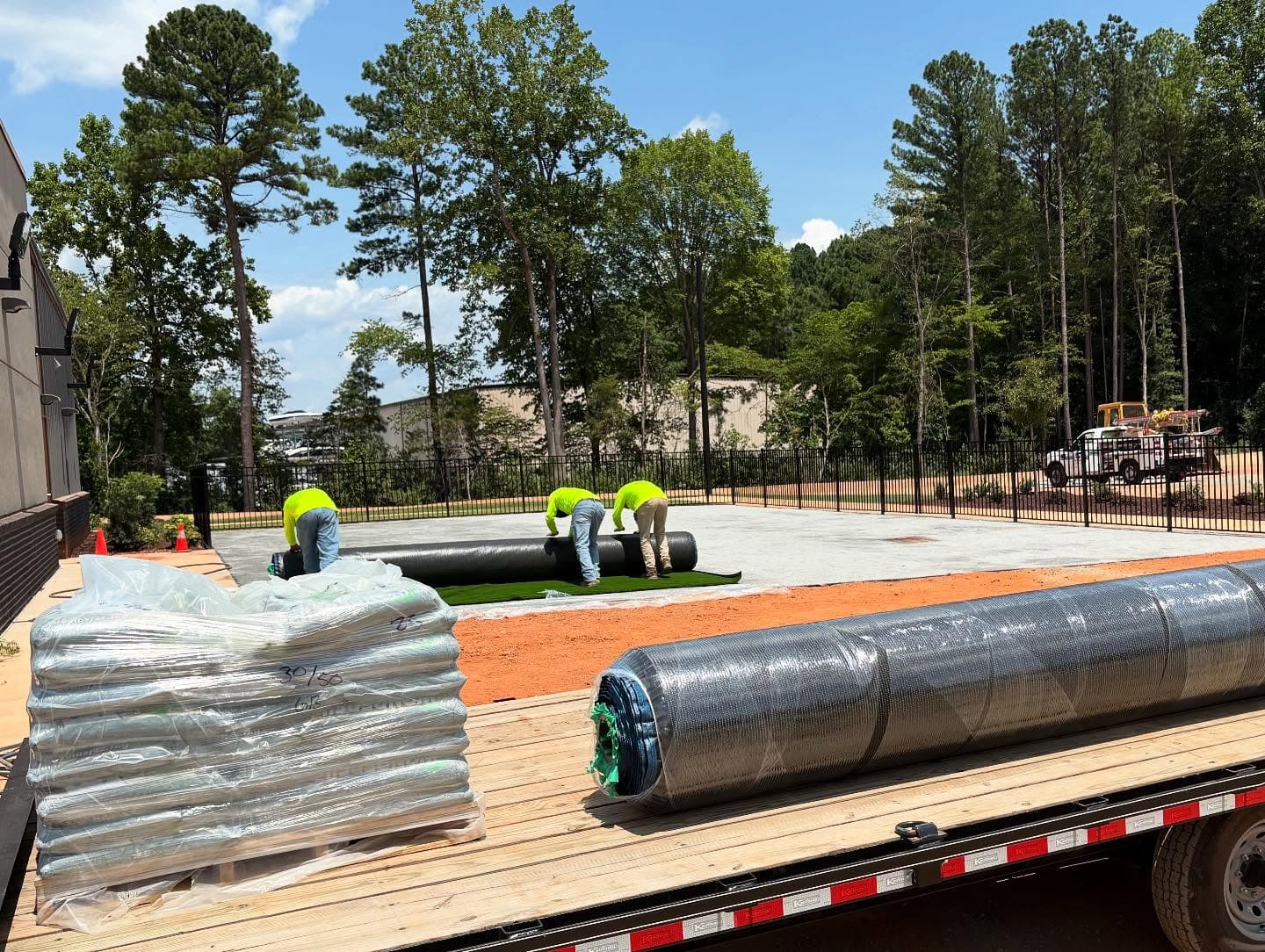
Artificial turf does not fail because the turf wears out. Premium synthetic grass carries 15-year warranties and routinely outlives them. When we get called to diagnose a lawn that has gone wrong in Charlotte — standing water after a thunderstorm, low spots that pool, seams that have separated, edges lifting away from a patio, a surface that feels spongy underfoot — the turf is almost always fine. The base under it was built wrong.
And the reason it was built wrong is usually the same: the crew installed a base designed for well-draining sandy soil on top of Charlotte's Piedmont red clay, which behaves nothing like sand.
What Makes Charlotte's Soil Different
The Charlotte region sits in the Piedmont physiographic province, on soils weathered from ancient granite and gneiss bedrock. The result is the distinctive orange-red clay that anyone who has dug a fence post here knows well. Its defining engineering characteristics matter enormously for turf:
- Extremely low permeability: Clay soils drain at a fraction of the rate of sandy soils. Water that reaches the clay layer does not move down — it moves sideways or sits.
- Shrink-swell behavior: Piedmont clay expands when saturated and contracts as it dries. That seasonal movement is what heaves poorly built bases out of level.
- Compaction sensitivity: Clay compacts into a nearly impermeable pan under equipment traffic, which makes drainage worse during construction, not better.
- Plasticity when wet: Saturated clay loses bearing strength and turns to a slick paste, so grading over wet clay without a proper aggregate layer creates a moving subgrade.
- Substantial annual rainfall: The region receives roughly 43 inches of rain a year, frequently in intense summer thunderstorm bursts that test drainage capacity all at once.
Put simply: in Phoenix or Las Vegas, water that passes through turf keeps going down into sandy soil. In Charlotte, water that passes through turf hits a clay layer and stops. Your base has to be designed to move that water somewhere.
What Correct Base Preparation Looks Like
Step 1: Excavation to Real Depth
Existing sod, organic topsoil, and root mass all have to come out. Organic material decomposes, and decomposition creates voids, and voids become the low spots you see two summers later.
- Residential lawn areas: 4 to 6 inches of excavation
- Putting greens: 6 to 8 inches, because contour precision and ball roll depend on a deeper, more stable profile
- Pet areas: 5 to 7 inches to accommodate a deeper, more freely draining profile for urine flushing
- High-traffic and commercial areas: 6 to 10 inches depending on load
A crew that shows up planning to lay turf over scalped existing grass, or excavating two inches, is not building something that survives Charlotte's freeze-thaw and shrink-swell cycles.
Step 2: Subgrade Shaping and Positive Drainage
This is the step that separates installers. Before any aggregate goes down, the exposed clay subgrade itself should be graded to shed water toward a defined discharge point — never toward the house, and never toward a neighbor's lot or a common area. A minimum fall of roughly one to two percent across the subgrade means that even in the worst case, water reaching the clay has a direction to travel.
Step 3: Geotextile Separation Fabric
A woven geotextile between clay subgrade and aggregate base does two jobs that matter specifically on clay: it prevents fine clay particles from migrating up and clogging the void space in your aggregate, and it distributes load so the base does not punch down into soft clay. Skipping fabric on Piedmont clay is a false economy — the base slowly contaminates itself and loses permeability over a few seasons.
Step 4: Engineered Aggregate Base in Lifts
The base is the actual structure. On clay, it needs to both drain and stay stable:
- Open-graded drainage layer: A washed, angular clean stone layer placed directly on the fabric creates void space where water can move laterally instead of pooling at the clay interface
- Dense-graded surface layer: A crushed stone with fines on top, which compacts to a tight, screedable, dimensionally stable surface that will hold contour
- Placement in lifts: Aggregate compacted in 2-inch lifts rather than one thick dump, because a single deep lift cannot be compacted uniformly through its full depth
- Angular, not rounded: Angular crushed stone interlocks mechanically. Rounded river gravel shifts under load and never locks up.
Step 5: Compaction to Target Density
Each lift gets compacted with a plate compactor or roller, with light moisture to help the fines lock. The finished base should be firm enough that a boot heel leaves no impression. Under-compaction is the direct cause of the soft, spongy feel and the gradual low spots that show up in the second and third year.
Step 6: Supplemental Drainage Where the Site Demands It
Many Charlotte lots — particularly on sloped sites, in older neighborhoods with high water tables, or in low-lying areas near creeks — need more than a permeable base:
- Perforated French drains within the base profile, routed to daylight or to an existing storm structure
- Channel or trench drains at hardscape transitions where sheet flow concentrates
- Catch basins at unavoidable low points, tied into subsurface pipe
- Downspout integration so roof runoff is carried under the turf rather than discharged on top of it — this single detail resolves a surprising share of "my turf floods" calls
Step 7: Perimeter Edge Restraint
On clay, seasonal soil movement pulls at unrestrained edges. Turf should be mechanically secured at every perimeter — nailed into a buried bender board, tucked and fastened against hardscape, or trenched and backfilled. Loose edges are how lifting starts.
How to Read a Bid: Six Questions Worth Asking
Base work is invisible once the turf is down, which is exactly why it is the first thing cut from a cheap bid. Ask any installer:
- How deep are you excavating, and where is the spoil going? A vague answer, or a number under four inches, is a red flag.
- What aggregate are you using, and in how many lifts? You want specific material names and lift thickness, not "gravel."
- Are you installing geotextile fabric over the clay? On Piedmont clay this should be a yes without hesitation.
- How are you compacting, and to what standard? Plate compactor or roller, lift by lift.
- Where does water go once it passes through the turf? They should be able to point at a discharge location on your specific lot.
- What does the warranty cover — material only, or installation and base? A material-only warranty means base failure is your problem.
If two bids are separated by a large margin, the difference is almost never the turf. It is excavation depth, aggregate tonnage, fabric, and drainage.
Warning Signs of a Failing Base
If you already have turf and are seeing any of these, the base is the likely culprit:
- Water standing on the surface more than an hour after rain stops
- A spongy or hollow feel when you walk certain areas
- Visible depressions or dips that were not there at install
- Seams that have opened or lifted
- Turf pulling away from a patio, walkway, or driveway edge
- Persistent odor in pet areas, which indicates urine is not flushing through the profile
- Wrinkles or ripples appearing after a wet season
Some of these can be corrected locally. Widespread settlement or drainage failure usually requires lifting the turf and rebuilding the base, which is why getting it right the first time is so much cheaper than getting it fixed.
Local Experience Is Not a Marketing Line Here
An installer who learned the trade in Arizona or Florida and relocated is working from a playbook built for soil that drains on its own. Charlotte's red clay punishes that assumption. Atlantic Turf Specialists builds every base for Piedmont conditions — full-depth excavation, geotextile separation, layered and compacted angular aggregate, engineered positive drainage, and mechanically restrained edges — across Charlotte, Huntersville, Cornelius, Davidson, Lake Norman, Mooresville, Concord, Matthews, Mint Hill, Indian Trail, Waxhaw, and Fort Mill.
Want to know what your specific lot needs? Request a free on-site assessment — we will evaluate your soil, grade, and drainage before quoting a single square foot.